
1. Read the current changes as workflow choices
Two recent changes matter operationally. OpenAI's October 26–30 update places GPT-6.1 Terra in Work and Codex. Claude's unified Plugins page began rolling out October 29, with November 9 general availability and November 30 Enterprise timing stated in its guide. Those future dates are not proof that every account already has the interface on November 3.
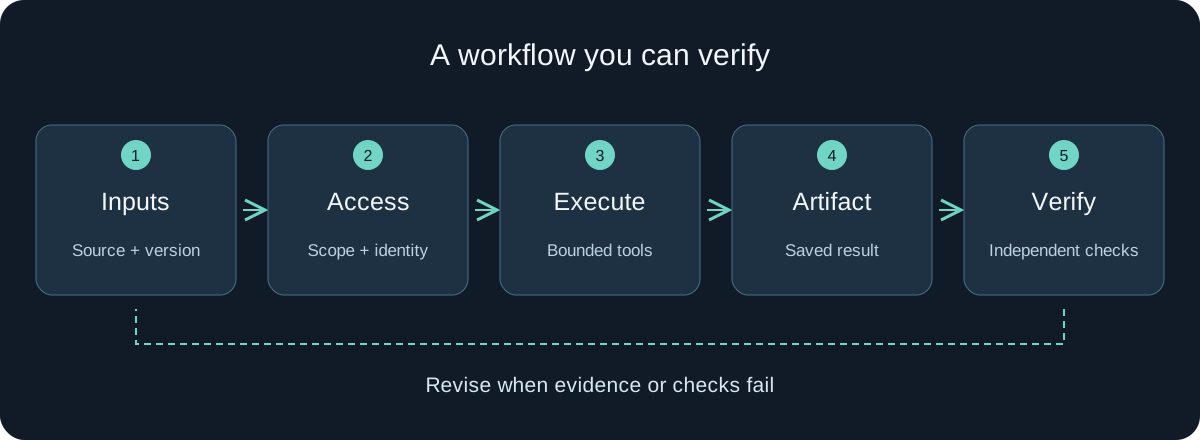
The useful question is which task becomes easier to specify, execute and check. A new model name does not connect a drive, grant repository write access or make a spreadsheet correct. Start from the five-step diagram below. Keep the task's inputs, available authority, execution environment, saved output and independent checks visible throughout the run.
Consider a product-launch review: the research brief, code patch, budget workbook and customer email are four deliverables with different failure modes. One conversation can coordinate them, but each needs its own evidence. This article offers an operating method, not a benchmark ranking, account eligibility determination or report of work we executed.
Official sources for this section: October 26–30 product update · Claude Plugins rollout
2. Choose the product surface before the model
ChatGPT distinguishes short-answer Chat from deliverable-oriented Work. Codex supports subscription sign-in and usage-billed API-key sign-in, with different governing controls. Record that path explicitly. Claude conversations, Claude Code and Claude Platform requests likewise represent different execution and entitlement choices; a familiar logo does not identify the entire workflow. Work Cloud requires the connected computer to stay online for its local files and tools. A continuation in a cloud container cannot access resources on an offline computer.
Use the table as an initial routing rule. If an existing document is the source of truth, prefer an approved in-place integration or a clearly versioned copy. If the deliverable is a code diff, choose an environment where the repository and its real checks are available. Build an API integration when repetition and application-owned validation justify operating it.
Create a handover note whenever work moves between surfaces. List files already read, tools actually available, actions already taken and the next reviewer. Reattach authoritative material when necessary instead of assuming that a model name carries every previous conversation into a new environment. A portable task bundle is more dependable than an undocumented chain of chats.
| Needed result | Candidate surface | First acceptance question |
|---|---|---|
| Explanation or short rewrite | Claude conversation or ChatGPT Chat | Does the answer use the supplied facts and requested scope? |
| Research brief or finished office file | Claude with approved tools or ChatGPT Work | Can you inspect sources and open the saved deliverable? |
| Repository change | Claude Code or Codex | Can the environment run the project's meaningful checks? |
| Repeated extraction inside a product | Claude Platform or OpenAI API | Who validates input, output, permissions and billing? |
| Shared team process | Approved team or enterprise workspace | Who owns connections, access, retention and final review? |
Official sources for this section: ChatGPT Work guide · Authentication and billing path
3. Research: demand an evidence ledger before a recommendation
Claude's current Research guide makes a consequential distinction: mobile research searches the web without connectors; web and Desktop can use connected tools. Remote connectors originate from Anthropic's infrastructure. Confirm the actual source path before asking for an internal-versus-public comparison. A missing internal result can mean an unavailable tool rather than an absence of evidence.
Prepare a bounded question, an as-of date and source priorities. Ask either system for a ledger containing each claim, source URL or document identifier, publication date, relevant passage and uncertainty. Read the primary pages behind important claims. Three reports repeating one announcement are not three independent confirmations. An inaccessible source should remain inaccessible in the report. Disable write-capable tools that the research task does not need.
For a supplier comparison, freeze the candidate list and distinguish price, technical capability, availability and contractual promises. Require a contradiction column and a list of facts that could change the decision. Accept the brief only when consequential claims are supported and recommendations are explicitly identified as analysis. Do not use citation count as a quality score.
Copyable task template — illustrative and unexecuted
Decision: [specific question]. As of: [date and timezone]. Use [approved sources] in priority order. Return an evidence ledger, disagreements, unknowns and a recommendation tied to criteria. Open primary sources for decisive claims. Mark unavailable sources. Do not contact anyone, change records or purchase anything. Stop with a reviewable brief.Official sources for this section: Claude Research sources and surfaces · Remote connectors and permissions
4. Code maintenance: compare reproducible changes, not attractive diffs
Claude Code permission modes and shell sandboxing control different layers. OpenAI also separates execution permissions from action approval. A request to plan first is useful, but prose alone is not an operating-system boundary. Begin in an isolated checkout with only the files, network destinations and credentials the maintenance task requires.
Supply the failing behavior, a minimal reproduction, expected behavior, relevant tests and exclusions. Ask for a diagnosis with file references before the patch. Preserve existing uncommitted work. A payment bug, for example, should not trigger unrelated formatting, dependency upgrades or a new checkout design. Small scope makes review and rollback more informative.
The acceptance bundle should include the diff, exact checks and their outcomes, an explanation of why the regression detects the original problem, and unresolved risks. Have an independent reviewer inspect authorization, error handling and ordinary cases near the defect. Passing a local test proves only the exercised snapshot; merge, deployment and runtime health are later outcomes.
Copyable task template — illustrative and unexecuted
In this disposable checkout, reproduce [bug] using [fixture]. Explain the cause with file references, then propose the smallest correction. Preserve unrelated changes. Allowed writes: [paths]; approved network: [destinations]. Run [meaningful checks] and record outcomes. Return the diff and remaining risks. Stop before commit, push, merge or deployment.Official sources for this section: Claude Code permission modes · Claude Code shell sandbox scope · Approvals and execution security
5. Documents and slides: review the exported object
Claude's October 6 Google Workspace announcement describes a paid-plan public beta for editing Docs, Sheets and Slides. ChatGPT's file guide distinguishes preview capabilities by surface. These are reasons to check the available editor and export path, not evidence that either product preserves every template or renders every file correctly.
Give the source material, audience, template, file type and delivery context. For a board memo, define which figures are authoritative, which passages require sources and whether recommendations may be added. For slides, state the decision each slide supports. Ask for an editable file plus a preview; a chat description of a deck is not the deck.
Open the final file in the intended viewer. Inspect headings, tables, page breaks, fonts, clipping, speaker notes and links. Recheck the exported PDF separately because it may differ from the editable source. Keep an approved original and a versioned result. Accept content accuracy and visual usability independently; a polished page can still carry an unsupported number.
Copyable task template — illustrative and unexecuted
Create [file type] for [audience] from [sources], following [template]. Preserve [required structure and facts]. Flag unsupported claims instead of inventing them. Return the editable file, an export/preview and a list of checks. Do not overwrite the approved original or share the file. Stop for review.Official sources for this section: Claude for Google Workspace beta · File creation and review
6. Data analysis: reconcile before interpreting
Structured output can help software read a result, but OpenAI's guide explicitly warns that structured values can still be wrong. Treat a valid table or JSON object as a format check. It does not establish that the right rows, units, joins or time interval produced those values.
Provide a data dictionary, timezone, reporting period, currency, primary keys and treatment of missing values. Keep the raw export unchanged. Require a cleaning log, excluded-row counts, duplicate handling and a reconciliation from raw totals to reported totals. A refund appearing in a later period can change the interpretation without being a calculation error.
Ask for formulas or a rerunnable script, not only a chart. Independently calculate a small sample and at least one aggregate. Test empty input, duplicate keys and a boundary date. Label whether a scenario is historical, forecast or assumption. An unexplained residual should block the recommendation rather than disappear into an attractive summary.
Copyable task template — illustrative and unexecuted
Analyze the read-only copy of [dataset]. Definitions: [keys, units, timezone and period]. Return a cleaning log, exclusions, reconciled totals, formulas or a reproducible script, and charts tied to those totals. Keep raw data intact. Flag unexplained differences. Do not submit filings, modify source records or treat a forecast as an observed result.Official sources for this section: Structured Outputs limitations
7. Agent tools: separate reading, drafting and committing
Both providers' connector or plugin controls sit alongside the connected service's permissions. Shared credentials can expose a broader scope than a user's own account. Inventory the actual connection and actions, then remove capabilities that the task does not need. An installed plugin is neither a business authorization nor proof that a write requires a fresh human prompt.
For a customer-update workflow, first retrieve approved records, then draft the message, then review recipients and content, and only then authorize sending. Keep the draft identifier and the final send receipt separate. For a purchase or deployment, record the permitted amount or target and the irreversible step. A model saying done is not an external receipt.
Design interruption handling before recurring use. A lost response after a write is an uncertain outcome, not permission to repeat it. Look up the operation using a stable business identifier and reconcile the result. Stopping a conversation also needs a separate check of delegated work and future schedules. Keep retries limited to operations whose repeated effects are understood.
Copyable task template — illustrative and unexecuted
Use [connection] only to read [approved scope] and create a draft of [artifact]. Show source references, destination and proposed changes. Stop before sending, publishing, deleting or spending. If the result of a previous action is uncertain, inspect its receipt/status before retrying. Report completed actions separately from proposals.Official sources for this section: Workspace plugin controls · Remote connectors and permissions
8. Choose by the bottleneck you can actually observe
Use a short decision sequence: identify the deliverable, confirm the permitted input path, confirm the required tools, and then select an available model. Keep model reasoning settings, tool access and input snapshots fixed when comparing. If one candidate has internal search and the other receives an old export, you are comparing workflows as well as models.
The table suggests starting points, not a measured superiority claim. When both products satisfy the hard requirements, give them the same representative tasks and score accepted artifacts, unsupported claims, repairs and elapsed end-to-end time. Include setup and review. A quick first answer can lose its advantage when a person must reconstruct missing evidence.
Set a threshold before opening the results. For a research task, an unsupported decisive claim might be a rejection regardless of prose quality. For a patch, failing the relevant regression can outweigh a strong explanation. For a draft, a reviewer may accept minor stylistic revisions. Write those rules down so a preferred brand does not silently move the goalposts.
| Observed bottleneck | Practical starting point | Decision gate |
|---|---|---|
| Scattered evidence | Research with authorized source access | Consequential claims link to opened evidence. |
| A reproducible repository defect | Claude Code or Codex in a controlled checkout | Independent regression and nearby normal cases pass. |
| A template-heavy deliverable | Approved file editor or Work/Claude artifact flow | Editable source and final export both open correctly. |
| Repeated structured processing | Application-owned API workflow | Schema, factual checks, retries and spend controls hold. |
| Action in another system | Narrow approved connector or browser workflow | Permission and external receipt confirm the intended change. |
| Team-wide repetition | Managed workspace and reusable task package | Ownership, permissions and support process survive handover. |
Official sources for this section: Model availability · ChatGPT Work guide
9. Map data and regional requirements at every hop
Anthropic distinguishes commercial and consumer data terms; OpenAI Work follows the applicable workspace's controls. No training, no retention and local execution are different properties. Inventory source files, prompts, tool results, generated artifacts, logs, backups and destinations. A deletion in the chat cannot be assumed to delete a copy already written elsewhere.
A concrete availability example is Terra's lack of UAE inference residency support. That is a workload-residency condition, not a statement that a person's physical location alone determines access. Record the workspace's required region and the actual feature path. An interface offering a model is weaker evidence than confirmation that the required configuration is supported.
For sensitive work, use an approved redacted fixture first. Confirm who can view the task and output, whether connections are personal or shared, and which retention policies govern each system. Keep secrets outside prompts and generated reports. Ask the organization's owner to resolve contractual coverage before introducing confidential customer material; do not infer coverage from a paid receipt.
Test access with both a permitted and an excluded synthetic record. If a shared connection returns the excluded record, change the connection or audience before continuing. Keep a destination list for exports and generated links too. Knowing where an agent can read is not enough when its output can expose those contents to a wider audience.
Official sources for this section: Claude commercial and consumer data scope · Work administration and data boundaries · October 26–30 product update
10. Measure the cost of accepted work and check the billing path
Eligible Claude Max, Ultra and Team subscriptions can claim conditional Console API credits; those credits do not increase interactive plan limits. Codex API-key use follows Platform billing. Check the current linked organization, credential path, balance and expiry rather than assuming subscriptions provide either unlimited API calls or no API benefit at all. OpenAI also offers conditional API credits for qualifying Pro and Business subscriptions linked to an API organization you own. They exclude Codex API-key usage and do not increase ChatGPT or subscription-signed-in Codex limits.
Use accepted tasks as the denominator. Count subscription or API usage, tool charges, execution compute, repeated attempts and human correction. Keep one-time setup separate from recurring operation. If only eight of ten reports pass review, divide the full batch cost by eight; do not report the price of the first successful-looking answer as the cost of delivery.
Define a stop budget before a pilot: maximum iterations, runtime, external actions and reviewer effort. Record failed runs and missing capabilities. A product may be suitable for one department's templates and unsuitable for another's data boundary. Your local evidence can support that scoped decision without claiming a universal ranking or a savings percentage we have not measured.
Official sources for this section: Claude monthly API credits · Authentication and billing path · Conditional API credits for ChatGPT subscribers
11. Run a small pilot with independent acceptance gates
Choose a small, representative set of authorized tasks with known-good references and a named reviewer. Include a missing source, a malformed file, a failed tool and an interrupted run. Keep inputs frozen and save the environment, account surface, model selection and prompt revision. This is a proposed pilot matrix, not a set of tests performed for this article.
Mark each task accepted, rejected or unresolved, with a reason. Keep tool unavailability separate from analytical mistakes and source-quality problems. A failed negative test should stop broader access. After a model, plugin, client or policy update, repeat the cases affected by that change instead of relying on an old all-clear.
For example, remove a cited attachment from one research fixture. A reliable outcome is an explicit gap, not a reconstructed quotation. In a data fixture, supply a duplicate transaction and require its treatment to appear in the reconciliation. These harmless negative cases show whether the workflow makes missing evidence visible before a reviewer has to discover it accidentally.
| Task | Minimum input | Reviewable artifact | Independent gate |
|---|---|---|---|
| Research | Question, cutoff and source scope | Claim ledger and brief | Open decisive sources; check contradictions. |
| Code | Snapshot, reproduction and expected behavior | Diff and check log | Regression detects original defect and verifies fix. |
| Document | Sources, audience and template | Editable file and export | Facts, layout, links and pagination checked. |
| Data | Raw copy and data dictionary | Cleaning log, formulas and report | Row counts and totals reconcile. |
| Agent action | Approved target and action scope | Draft, change record and receipt | Intended external state confirmed without duplicate effects. |
| Team rollout | Owner, roles and data policy | Reusable task package and runbook | Another authorized user can repeat and safely stop it. |
Official sources for this section: File creation and review · Approvals and execution security
12. Package a reusable task contract and improve it from failures
Use the template below as a starting contract for either provider. Replace every bracketed field and attach only necessary material. Keep the outcome and reviewer specific. A prompt tells the agent what you want; enforce access and execution limits through the actual workspace, tools and environment too.
After each accepted run, save the input manifest, prompt version, artifact and verifier result. Turn stable repetition into an approved reusable skill, plugin or application workflow. Review the package when sources, permissions or business rules change. A shared prompt without an owner, test case or retirement path becomes another uncontrolled dependency.
The remaining unknowns are account-specific rollout, exact entitlement, third-party behavior and your task's performance. Resolve them through the current console, administrator and bounded pilot. Choose Claude or ChatGPT where the full input-to-acceptance path fits, and keep the evidence that explains the choice.
A useful task package also records its supported input shapes, version owner, test fixtures and rollback instructions. Name which changes require reapproval, such as a new destination or broader write access. When a connector disappears or a template changes, the package should fail visibly or return a limited draft. Silent substitution makes both quality and cost comparisons difficult to interpret.
Copyable task template — illustrative and unexecuted
Outcome: [deliverable, audience and decision]. Inputs: [approved files/sources, versions and cutoff]. Authority: [reads, writes, network and explicit exclusions]. Method: [evidence rules and required tools]. Deliver: [editable artifact, source ledger and execution record]. Accept only if: [independent checks]. Budget: [time, iterations and spend]. Stop for review before: [named external or irreversible action]. Unknowns: report them; do not invent missing evidence.Official sources for this section: Workspace plugin controls · Work administration and data boundaries